
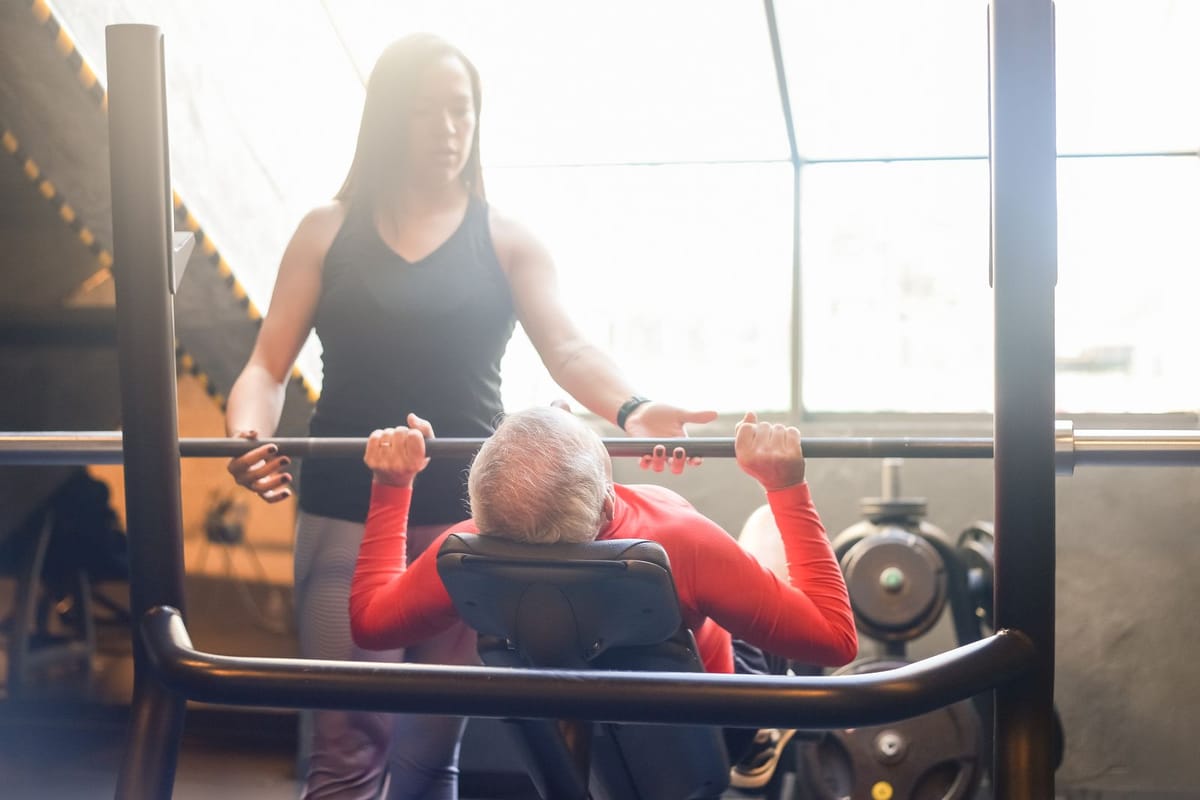
How to Start Strength Training After 40
Starting after 40 follows the same principles as at any age, with more attention to warm-up, joint-friendly exercise choices, and recovery.
- Check your health first. If you have heart, metabolic, or kidney disease, or symptoms such as chest pain, unusual breathlessness, or dizziness during activity, get medical clearance before starting.
- Get a movement baseline. A movement screen shows limitations in the hips, ankles, and shoulders.
- Train two or three days per week, with about 48 hours between sessions for the same muscles.
- Start lighter than you think, using loads you can lift for 10 to 12 controlled reps.
- Progress gradually, adding a little weight or a rep or two once every set feels controlled.
The U.S. Physical Activity Guidelines recommend muscle-strengthening activity for all major muscle groups on two or more days per week, plus 150 to 300 minutes of moderate aerobic activity. Adults 65 and older are also advised to include balance training. Simple balance work, such as single-leg stands and step-ups, fits easily into a warm-up.
The Best Strength Exercises for Adults Over 40
| Movement | Joint-friendly choice | Why it works |
|---|---|---|
| Squat | Goblet or box squat | Controls depth, keeps torso upright |
| Hinge | Trap bar or kettlebell deadlift | Less stress on the lower back |
| Push | Incline dumbbell press or push-up | Often easier on the shoulders |
| Pull | Chest-supported row, lat pulldown | Builds upper-back strength for posture |
| Single leg | Split squat, step-up | Improves balance and hip stability |
| Carry | Farmer's carry | Trains grip and trunk control |
Sets, Reps, and Progression After 40
For most people, 2 to 3 sets of 8 to 12 reps per exercise, with 1 to 2 minutes of rest, builds strength and muscle effectively. Increase load by the smallest available amount once you reach the top of the rep range on every set. A strength and conditioning program adds power and conditioning work later, once the foundation is in place.
- Monday: goblet squat, incline dumbbell press, cable row, farmer's carry.
- Wednesday: trap bar deadlift, lat pulldown, step-up, side plank.
- Friday: split squat, chest-supported row, shoulder press, Pallof press.
- Warm-up: 8 to 10 minutes of light cardio, mobility drills, and lighter warm-up sets. Our guide to mobility vs. flexibility explains which drills help most.
- Load increases: keep them small, because tendons adapt more slowly than muscle.
- Rest between sets: 1 to 2 minutes for most exercises, slightly longer for heavy lower-body lifts.
Adjusting for Common Over-40 Concerns
- Morning stiffness: extend the warm-up or train later in the day.
- Lower back sensitivity: use a trap bar or kettlebell and build core endurance with dead bugs, side planks, and bird dogs.
- Shoulder discomfort: choose incline, neutral-grip, or landmine presses over behind-the-neck movements.
- Bone health around menopause: bone responds to progressively heavier loading. Anyone with diagnosed osteoporosis should follow guidance from their doctor or physical therapist on loading and spinal flexion.
- Past injuries: our injury rehabilitation program bridges physical therapy discharge and regular training.
Why Strength Training Matters More After 40
From around middle age, adults gradually lose muscle mass and strength. When strength and muscle mass fall low enough to affect function, it is diagnosed as sarcopenia. Bone density also declines, and bone loss speeds up for women around menopause as estrogen falls. Regular resistance training helps maintain muscle and strength, supports bone health, improves insulin sensitivity, and supports balance. It also helps many people maintain energy, sleep quality, and confidence in everyday tasks.
Recovery and Progress Markers After 40
Recovery often takes a little longer with age. Prioritize seven or more hours of sleep, spread protein across meals, and take a lighter week every four to eight weeks if joints or energy start to lag. You are progressing well if weights or reps rise every one to two weeks, joints feel the same or better, and daily tasks such as carrying groceries or climbing stairs feel easier. A 3D body scan confirms whether lean mass is increasing.
Private Coaching for Adults Over 40 in Seattle
In 1-on-1 personal training, each 60-minute session is adjusted to how your body feels that day, and our custom training programs are written around your history and goals. Clients from Capitol Hill, Queen Anne, and Wallingford train with the same coach every session at our Eastlake studio.
Frequently Asked Questions About Strength Training After 40
Is it too late to start strength training at 40, 50, or 60?
No. Research consistently shows that adults gain strength and muscle from resistance training at any age, including people in their 70s and older. The key is starting at the right level, using joint-friendly exercise choices, and progressing gradually. Many people who start in their 40s or 50s become stronger than they were in their 30s. A coach can help you choose a safe starting point.
How often should you strength train after 40?
Two to three full-body sessions per week is a strong target for most people over 40. That meets the national guideline of muscle-strengthening activity on two or more days per week and leaves about 48 hours of recovery between sessions for the same muscles. Walking or other moderate cardio fills the remaining days. Two sessions still produce meaningful results if that is all your schedule allows.
Can you build muscle after 40?
Yes. Muscle still responds to progressive overload, adequate protein, and good sleep after 40. Progress may be slightly slower than in your 20s, but consistent training produces measurable gains in lean mass and strength. Tracking with a 3D body scan shows lean-mass changes that a bathroom scale misses. Consistency over months, supported by enough protein and sleep, matters more than any single workout.
Should women over 40 lift weights?
Yes. Strength training is especially valuable around perimenopause and menopause because it supports bone density, lean muscle, and body composition while estrogen levels change. Moderate to challenging weights build strength and a firmer shape without creating a bulky look. Progressive loading over time matters most for bone health. Women with diagnosed osteoporosis should get guidance from their doctor or physical therapist on loading.
What exercises should you avoid after 40?
No exercise is automatically off-limits, but some are poor starting points: high-impact jumping, maximal one-rep lifts, behind-the-neck presses, and heavily loaded spinal flexion. Begin with joint-friendly variations such as goblet squats and trap bar deadlifts, then earn harder versions as strength and control improve. A coach can tell you when you are ready for each progression.
Is strength training or cardio better after 40?
Both matter. Cardio supports heart health and endurance, while strength training preserves muscle and bone. A balanced week includes two to three strength sessions plus regular brisk walking or other moderate cardio. If you currently do only cardio, adding strength work is usually the bigger opportunity. Both fit in the same week without hurting recovery, and brisk walking on non-lifting days can even aid it.
How much protein do you need after 40?
Many experts suggest active adults aim for roughly 1.2 to 1.6 grams of protein per kilogram of body weight per day, spread across three or four meals. Older adults may benefit from the higher end of that range. If you have kidney disease or another medical condition, check with your doctor before increasing protein. Lean meats, fish, eggs, dairy, legumes, and tofu are all useful sources.
Can strength training help with joint pain?
Often, yes. Stronger muscles around the knees, hips, and back can reduce joint stress, and exercise is a recommended treatment for knee and hip osteoarthritis. Sharp, worsening, or swollen joints should be assessed by a medical professional first. Gradual loading is key. Our post on knee pain and rehabilitation covers a common example.
Is semi-private training a good option after 40?
Yes, once you are comfortable with the basic lifts and have no active injury. Semi-private training gives you an individual program with up to four clients per coach at a lower cost per session. Compare both formats in private vs. semi-private personal training. Many clients start 1-on-1 and transition later.
Where can I find strength training for adults over 40 in Seattle?
Eastlake Performance is a private training studio at 2926 Eastlake Ave E in Seattle, open weekdays 6 AM to 8 PM and Saturdays 8 AM to 2 PM, with free garage parking. Every new client starts with a 60-minute assessment. Contact us to schedule a free intro call, or meet our coaching team.